The following is my presentation on a grade 7 Language Arts activity, focusing on the social justice issue of child slavery. I used a children’s book titled The Carpet Boy’s Gift written by Pegi Deitz Shea because it is based on a true story and the book provides pages at the back which tell you where you can find more information on the true events that took place. I also like this book because you can take it in any direction!
As part of my preservice teacher education, I designed this activity for a grade 7 class. It is an introduction activity that can be taken in multiple directions. The general ideas in this activity is to read about a different culture, study a social justice issue, and relate it back home to develop an action plan. I hope you enjoy this activity!
Minds on:
I like to get students engaged by asking them relevant questions and to get them thinking about the topic I’m presenting to them.
- What do you think of when you hear the term child slavery?
- What does child slavery mean?
I give students a couple of minutes to discuss their thoughts with their peers.
Next, we read the book as a class.
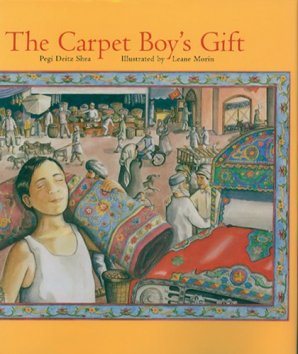
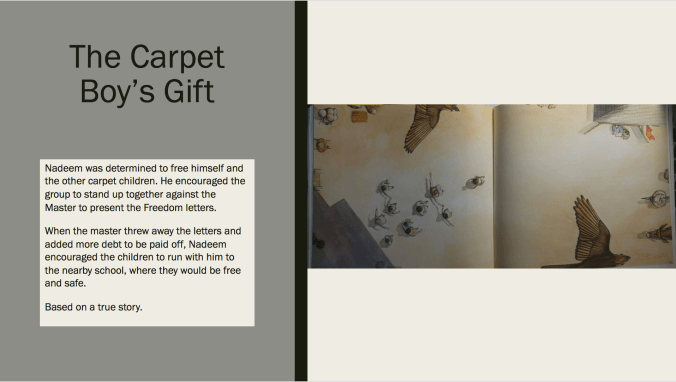
This is the summary I made for my presentation:
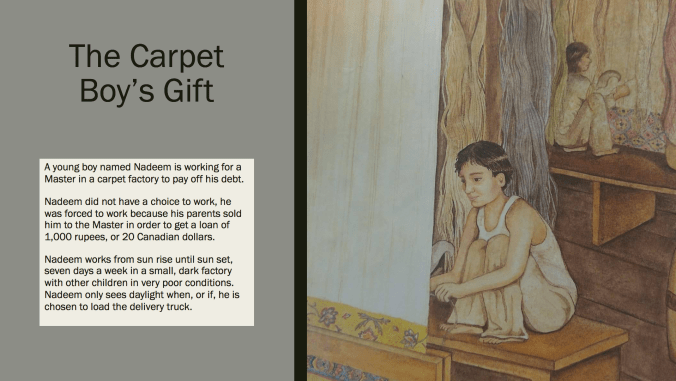
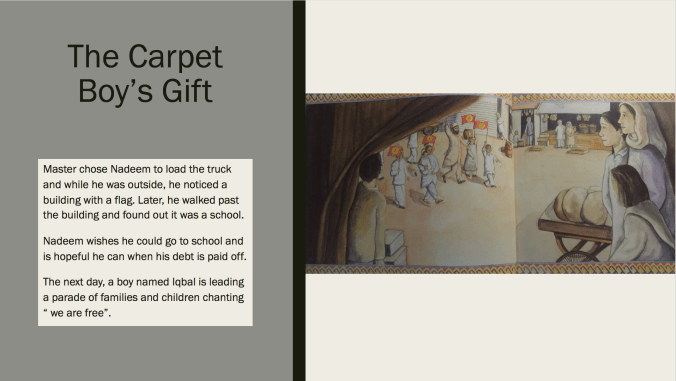
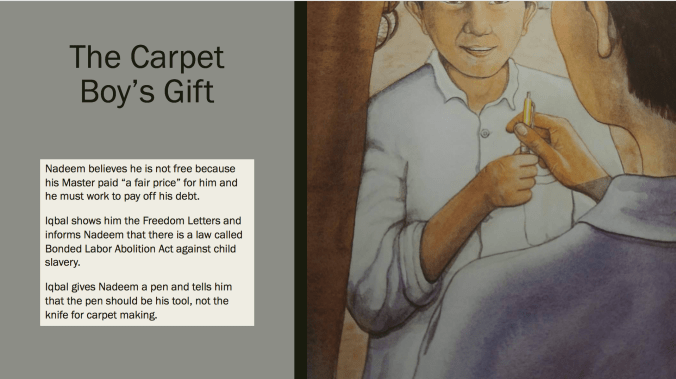
Group discussion:
- Was Nadeem and the carpet children a child slav or child labourer?
- What do you think the difference is?
- Justify your answer
After we read, we looked at the website antislavery.org and specifically this link:
https://www.antislavery.org/slavery-today/child-slavery/
We read the sections:
- What is child slavery?
- Said and Yarg’s Story
- Child slavery includes
- Why do children work?
Change this idea by having students explore this page individually. Have them fill out a work sheet or discuss what they have read with a peer.
Action:
Next, I introduced the United Nations Conventions on the Rights of the Child
- What is the United Nations Conventions on the Rights of the Child?
- The United Nations Conventions on the Rights of the child (commonly abbreviated as the CRC or UNCRC) is a human rights treaty which sets out the civil, political, economic, social, health and cultural rights of children.
Activity:
- Each person in the class will have an article from the united nations
- Take a minute to read the article and think about what it means
- Write the article in your own words (plain/ child-friendly text)
After students write the article in his or her own words, we compare their article to the one written in the official child-friendly articles. Click here for the UNCRC Child-friendly poster of the articles.
Discussion questions:
- Why do you think it is important that the UN made this convention on behalf of children?
- How many of you believe that slavery still exists today?
Consolidation and Connection:
Activity:
Taking a look at popular North-American Brands
Companies that use Sweatshops/Child Labor
- Companies such as Adidas, Nike, Abercrombie & Fitch, Forever 21, Wal-Mart, Old Navy, Tommy Hilfiger, Ralph Lauren, H&M, Converse, Hollister and more uses child labor/sweatshops to make profit. It costs a lot to make items in North America or other developed countries than elsewhere, because they have higher minimum wages. For example, instead of paying $10 to someone making clothes in Canada per hour, companies can pay workers 10 cents (Canadian money) each week in India.
- Companies such as American Apparel, Roots, Canada Goose, Eddie Bauer, New Balance and Toms support sweat-shop free clothing. They suggest people to reuse and donate old clothing instead of buying new clothing to avoid using sweatshops.
Facts from EndModernDaySlavery.ca
- “It is said that in developing nations across the globe, roughly 250 million from the ages of 5-14 are being forced to work in sweatshops. This type of slave labor where pay is almost non-existent, is ruining the potential of many young children worldwide.”
- “A study showed that doubling the salary of all sweatshop workers would only increase the cost of an item you buy in a store by roughly 1.8%”
- “The majority of money earned by sweatshops workers is spent on food to get by and survive on- these jobs do not help families at all, they destroy them.”
Exit cards:
- What did you find the most surprising?
- How did it make you feel?
Please leave me a comment. I would love to know if you have explored this children’s book in your classroom and if so, how?!
 Teaching & Assessing
I think this is a great activity. I specially liked how you started with the book and then ended with talking about brands because I feel it that the story has the potencial to generate empathy and the section about brands can make the students really think about the impact of their buying choices. Thank you so much for sharing!
LikeLiked by 1 person
Thank you! I’m glad you enjoyed it and I hope it is useful to you!
LikeLike
This is awesome. I wish I’d been taught this lesson in seventh grade.
LikeLiked by 1 person
Thank you! I also wish I had been taught this much earlier in my life. However, it isn’t too late to start teaching this social justice issue to our youth and bring awareness about the impact our products and purchases make!
LikeLiked by 1 person